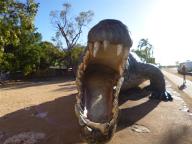
How Big Is Queensland

Aug 11 After 83 days and over 7,000 kilometres driven, we finally manage to escape our home state of Queensland.

Here are some interesting facts about Queensland :

• With an area of 1,727,000 square kilometres, Queensland is the second largest state in Australia. The biggest is Western Australia. Queensland is nearly 5 times the size of Japan, 7 times the size of Great Britain and 2.5 times the size of Texas.
• Queensland has 5 of Australia’s 11 World Natural Heritage areas. These include the Scenic Rim National Parks, Fraser Island, Riversleigh Fossil Fields, the Wet Tropics (including Daintree National Park), and 1 of the Wonders of the World—the Great Barrier Reef.
• More than half of Queensland’s population lives outside the greater metropolitan area of Brisbane—a large proportion compared with the rest of highly urbanised Australia.
• About 1/3 of Queenslanders are migrants or the children of migrants. Most settlers in Queensland during the 19th century were from Britain and Europe. In recent years there has been an increasing number of new settlers from South-East Asia.
• Queensland is home to more than 4 million people.
• The vast majority of Queensland receives an average of between 8 and 9 hours of sunshine every day.
• The multi-award winning Tjapukai Dance Theatre in Kuranda, North Queensland, featured in the 1997 Guinness Book of Records as the entry for the longest running show in Australia. The show ran from May 1987 to July 1996, with more than 7,000 performances and 1.2 million visitors.
• Queensland has more than 1000 species of native vertebrates, many of them unique to the region.
• The first Labor government in the world took office in Queensland in 1899.
• The international airline Qantas (Queensland and Northern Territory Aerial Services) was established in Longreach, Queensland, in 1920.
• There are over 200 national parks in Queensland, covering 6.5 million hectares.
• Four Queenslanders have been Prime Minister of Australia—Andrew Fisher (3 times: 1908–1909, 1910–1913 and 1914–1915), Arthur Fadden (1941), Francis Forde (1945) and Kevin Rudd (2007–2010).
• Free education was implemented in Queensland in 1870.
• The first Queensland railway opened in July 1865, from Ipswich to Grandchester.
• XXXX beer is one of Queensland’s well-known products and was established back in 1877.
• On 18 May 1907, women voted for the first time in a Queensland state election.
• Brisbane-born pioneer aviator Charles Kingsford Smith and his colleagues completed the first air crossing of the Pacific, from San Francisco to Brisbane, in 1928.
• Australian poet Banjo Patterson’s verse Waltzing Matilda was first sung publicly at the North Gregory Hotel in Winton, Queensland, on 6 April 1895.
• Queensland has the only State Parliament in Australia with 1 House, the Legislative Assembly. The Legislative Council (Upper House) was abolished in 1922.
• The Royal Flying Doctor Service started operating on 17 May 1928, when pilot Arthur Affleck flew the first flying doctor, Dr Kenyon St Vincent Welch, on the first official flight from Cloncurry to Julia Creek in response to an emergency call.
• The Australian Labor Party was formed in Queensland in 1891 following the bitter defeat of the shearer’s strikes of 1890–91.

Mount Isa

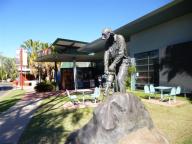
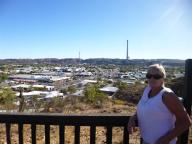
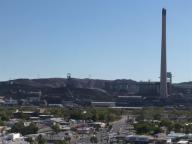
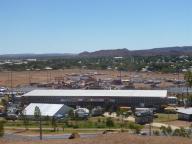
Aug 6 to 9 Mount Isa is a city in the Gulf Country region of Queensland. It came into existence because of the vast mineral deposits found in the area. Mount Isa Mines (MIM) is one of the most productive single mines in world history, based on combined production of lead, silver, copper and zinc. With a population of 22,000, Mount Isa is the administrative, commercial and industrial centre for the state’s vast north-western region. Although situated in an arid area, the artificial Lake Moondarra 19 km north of the city on the Leichhardt River provides both drinking water and an area for watersports, birdwatching and recreation. Locals often refer to Mount Isa as “The Isa”.

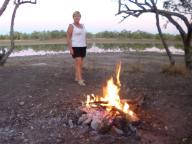
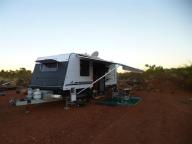
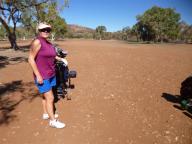
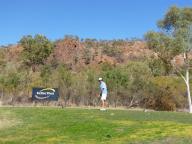
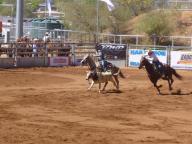
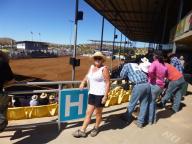
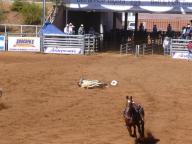
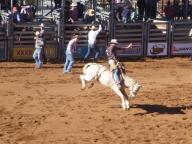
It just happened that we turned up at The Isa on the busiest weekend of the year – it was annual rodeo time (supposedly the biggest rodeo in Australia). If that is the case then I wouldn’t like to go to a small one !! But all the camp sites were full but we managed to free camp at the local golf course. We managed a game of golf but had difficulty actually finding the fairways (see pic of Siobhan who is in the middle of the 4th fairway).

Mount Isa has a great Irish Club where the Guiness is cold and poured correctly.

Cloncurry

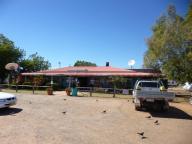
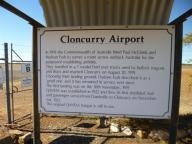
Aug 5 Cloncurry for an overnight stop before Mount Isa, with a coffee stop at the famous Burke and Wills roadhouse on the way. Cloncurry is the site of the first Flying Doctor flight and also the original Qantas base. (But not much else). There isnt even any water in the local river.

Burketown

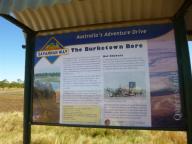
Aug 2, 3 Burketown is located 2,115 kilometres to the north west of Brisbane, with the nearest larger town being Cloncurry, 480 kilometres to the south. The town is roughly 30 kilometres inland from the Gulf of Carpentaria. It is located on the Albert River and Savannah Way in the area known as the Gulf Savannah. Burketown had a population of 173.

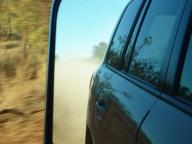
This is one town we thought we would not be able to make it to as the road from Gregory Downs was renowned as very rough. However, since the amount of mining in the area, the roads have been resurfaced and there is now only about 10 kms of dirt road which was quite passable.

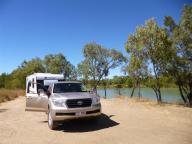
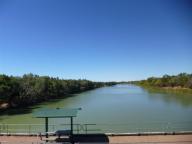
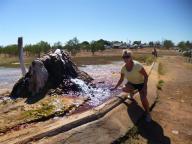
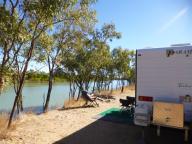
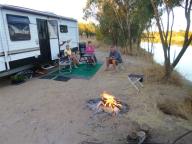
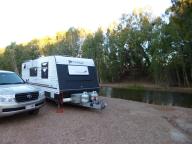
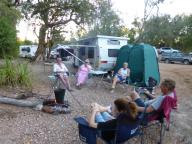
Again, we find a fantastic free camp spot right on the Albert River with a 3 metere bank to discourage any croc visits in the night. Camp fires are allowed and we needed them in the cool evenings.

Lawn Hill National Park

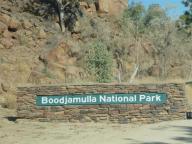
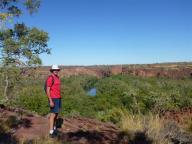
July 31 Lawn Hill National Park, also known as Boodjamulla, is approx 100 kms west of Gregory Downs over dirt roads. It 340 km northwest of Mount Isa or 1,837 km northwest of Brisbane.

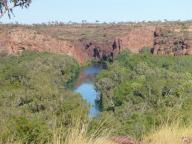
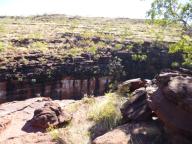
The main attractions in the park are the sandstone ranges with deep gorges and a limestone plateau with significant fossil fields. Other attractions include crystal-clear green waters, lush vegetation and canoeing.

The park contains several permanent creeks, waterholes, gorges, and sandstone ranges. Boodjamulla’s ancient sandstones and limestones have been gradually stripped away over millions of years leaving behind rugged escarpments, gorges, and rock outcrops.

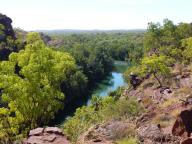
Lawn Hill Gorge, the primary attraction in the park, cuts through the sandstone plateau of the Constance Range, on the eastern extremity of the Barkly Tableland. The gorge has been carved out by Lawn Hill Creek, which flows all year and is fed by numerous freshwater springs from the limestone plateau to the west. The gorge is a rich oasis with cabbage palms and other tropical vegetation.

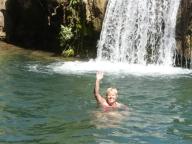
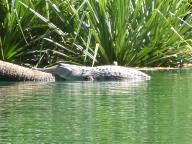
We take in some of the walks in the park and enjoy a canoe trip up the gorge with a refreshing swim at the cascades. We assumed the fresh water croc was plastic !!

Gregory Downs

July 30 to Aug 1 Gregory Downs is our base to visit the picturesque Lawn Hill National Park (see separate blog post). The town has a population of 40 and is situated on the banks of the perennial Gregory River, a fast flowing small river that is fed year round by a large spring.

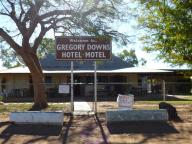
The town has a hotel that was originally built in the 1900s to accommodate travellers using the coach service to nearby Burketown. Previously the hotel also served as a post for the mounted police. The town itself is built on the homestead site of the historic Gregory Downs station, one of the first pastoral properties to be established in the Gulf Country.

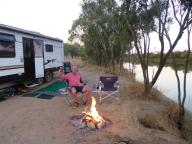
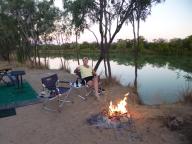
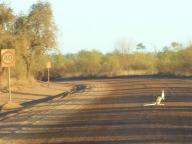
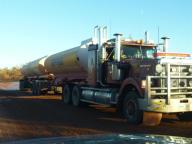
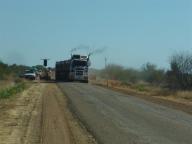
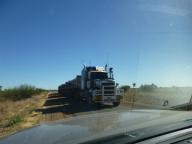
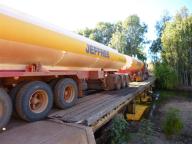
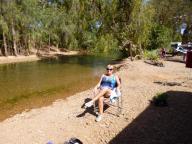
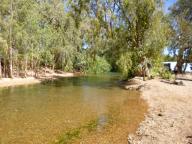
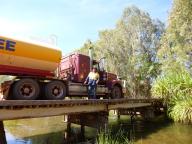
The free camp site is on the river banks and can be found easily by turning left at the ‘No Camping’ sign !! The roads are now truly outback style, quite narrow but at least they are bitumen. Large road trains are the kings of the road.

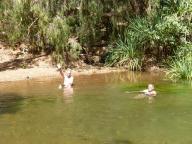
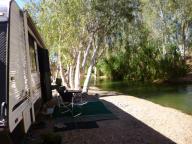
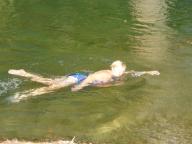
We cannot emphasise how beautiful the free camp is with your own fresh water swimming pool on the doorstep.

Finally We Make It To Karumba

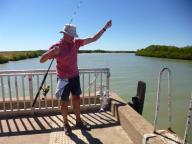
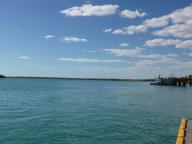
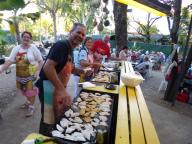
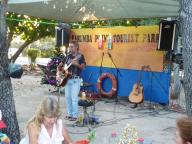
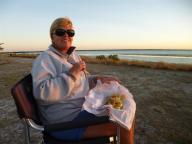
July 27 to 29 Karumba at last … only too much wind, no bait and no fish. Everyone is waiting for the blue salmon to arrive. We are a little disappointed obviously and even more so when we have to pay $29 a night for a dusty unpowered postage stamp. However, there are some highlights – the free fish BBQ at the camp kitchen on Saturday night … the free entertainment to celebrate Christmas In July (fortunately the grey nomad belly dancers remained fully clothed !! … fresh barra and chips at sunset. Take a look at the amusing weather rock.

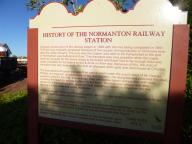
Normanton and The Gulflander Train

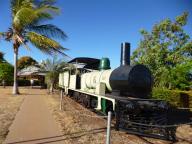
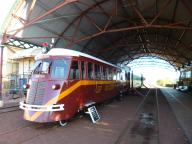
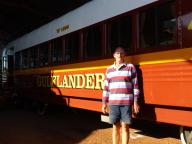
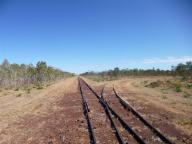
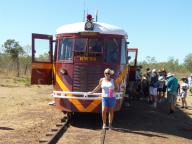
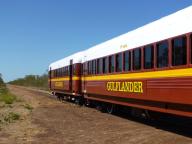
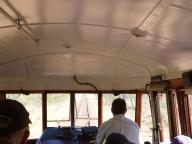
July 27 We make a day stop in Normanton on the way to Karumba to take a ride on the historic Gulflander train, a rail journey unlike any other. Originally built to connect the once bustling river port of Normanton with the rich gold fields of Croydon, today the Gulflander is a tourism icon and working tribute to the early pioneers of the Gulf of Carpentaria. Affectionately said to go from “nowhere to nowhere”, the Normanton to Croydon line was never connected to the state rail network. This isolated railway is heritage listed and the only line in Queensland still measured in miles.

The Normanton to Croydon line was laid in a fashion not found anywhere else in the world. With an innovative sleeper design, seasonal flood waters flow over the line to lessen flood damage. Testament to the ingenuity of this design is that today much of the line is still the original rail and sleepers laid between 1888 and 1891.
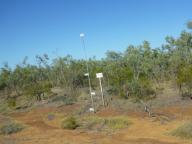
Note the flood markers along the line – take a look at how high the 1974 floods were.
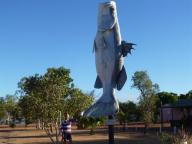
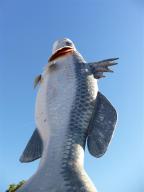
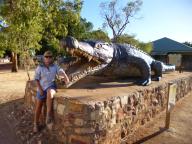
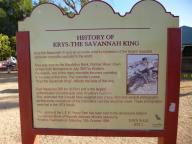
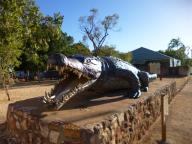
Normanton is also home to a Big Barra and the largest crocodile ever shot. It is 8.63 metres long and was shot by a female crocodile hunter in July 1957.