Winton

We camp behind the North Gregory Hotel in Winton for three nights to check out the dinosaur capital of Australia, so called because of the abundance of dinosaur fossils that have been found in the surrounding area – more of that later.

The Hotel only charges $10 per night with access to loos and showers but no electricity, which we do not require thanks to our solar panels.

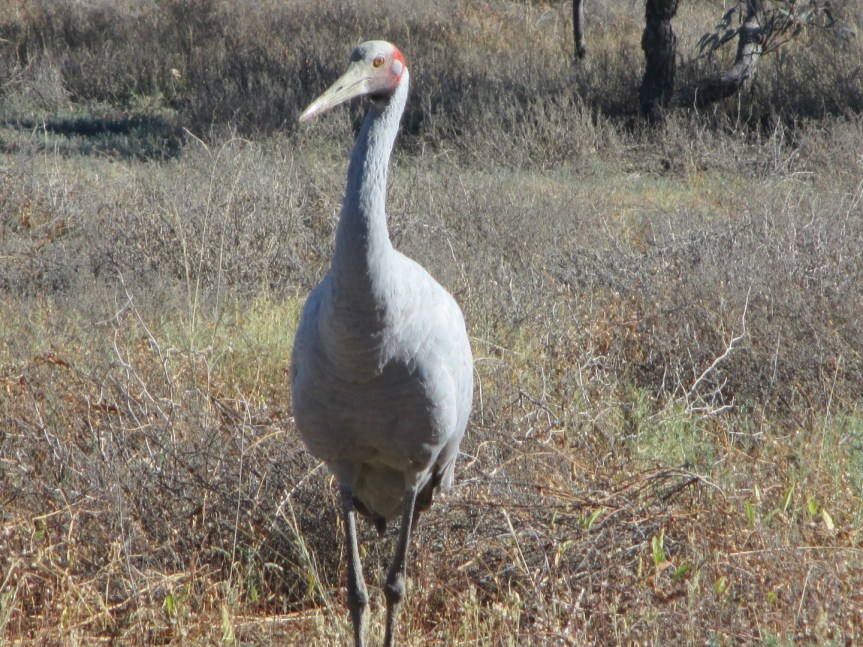
Note from the photos that there is a slight fly issue here. Also, all the litter bins are shaped like dinosaur feet. Emus are quite a common sight around Winton.


Winton has one quirky attraction – Arno’s Wall. A modern wonder of art and architecture, Arno Grotjahn’s wall contains almost every household item you can imagine and more. The walls reach two metres high and extend for at least 70 metres. They are constructed of concrete and rock brought from Arno’s opal mine at Opalton and studded with rusted lawnmower parts, boat propellers, vintage typewriters and sewing machines and even a couple of complete motorbikes.

Arno was born in 1930 and spent his youth as a merchant seaman travelling the world. He immigrated to Australia from Germany some 30 years ago and spends his time in and around Winton opal mining.

Longreach

Longreach is a town in Central West Queensland named after the “long reach” of the Thomson River on which it is situated. The town is on the Tropic of Capricorn. A number of Queensland towns have their streets named to a theme. In Longreach, the streets are named after species of birds, with the streets running east-west named after water birds and those running north-south after land birds.

Longreach is the home of the Australian Stockman’s Hall Of Fame which was officially opened in 1988 by Queen Elizabeth II. The purpose of the centre is to showcase the history and the culture of life in rural Australia. Since its opening, over 1 million people have passed through its doors.

Longreach was one of the founding centres for Australia’s airline Qantas. One of the airline’s original hangars remains in use at the airport. The town is now the home of the Qantas Founders Outback Museum, which includes amongst its displays a decommissioned Qantas Boeing 747-200 and Qantas’s first jet aircraft, a Boeing 707. In recognition of the town’s place in company history, as well as a play on the airliner’s extended range, all of Qantas’s Boeing 747-400’s have “Longreach” printed on both sides of the first jetway entry/exit doors.

A couple of highlights from our visit to the Qantas museum – standing in a Boeing 747 engine and walking on the wing of the same jumbo jet.

Barcaldine

After Emerald, next major stop will be Longreach. One overnight free camp at Jericho plus a quick stop on the way in Barcaldine.

Barcaldine played a significant role in the Australian labour movement and the birth of the Australian Labour Party. In 1891, it was one of the focal points of the sheep shearers’ strike, with the Eureka Flag flying over the strike camp. The landmark Tree Of Knowledge under which the strikers met, stood outside the railway station. (In 2006, persons unknown poisoned the tree with a herbicide, which led to its demise.) Today there is a replacement monument to the tree.


More From Emerald

The caravan park in Emerald where we are staying has come up with a great option for free-camping travelers – ie us. They have a large field at the rear of the camp which they let free campers use. Water can be topped up on the way in and all the other facilities of the van park are also available, loos, showers, camp kitchen, etc). But instead of paying $35 + for the van park we are only charged $12 per night. Full marks to them.

We take advantage of a country singer around the campfire and cannot go past the local Irish Pub for a pint of Guinness. And we finish off our visit back to Emerald with a round of golf.

Emerald

A step by step snapshot of Emerald’s history is situated in Morton Park, Emerald. This project was made possible by Centenary of Federation funding. The mosaic pathway depicts 100 years of Emerald’s history with 21 intricately tiled designs. The detailed mosaics were created by 10 of Emerald’s local artists.

At the end of the mosaic pathway is the Big Easel installation art piece, created by Canadian artist, Cameron Cross. Erected in 1999, the artwork depicts Dutch artist Vincent Van Gogh’s famous Sunflowers painting. Weighing approximately 17,000 kilograms, the steel easel measures 25 metres in height, with the canvas measuring 7 x 10 metres.

On Towards Emerald

Continuing the trip north, we travel through Monto (overnight free camp), Biloela, Moura (free camp), Rolleston, Springsure (overnight free camp at Virgin Rock) and then finally into Emerald for a couple of nights.

Monto is close to the Cania Gorge and Cania Dam, where we spent a week or so last year with friends Alan and Anne fishing and catching redclaw.

Biloela is named after the aboriginal word for the white cockatoo.

Virgin Rock, one of our overnight stops is 4 Kms north of Springsure. It is on the eastern side of Mount Zamia and has a naturally formed likeness to the Virgin Mary and Child (looked just like a normal rock to us !!). The spectacular cliffs are floodlit at night.

Next stop Emerald.

Yeahhhh !! Heading Up North For The Winter

It is that time of year again. Temperatures getting down to the mid teens at home means it is time to be chasing the sun and warmer climes in far north Queensland.

The caravan has undergone some major refurbishments after being hit by a hailstorm on our last trip in Nelson Bay.

Our first major stop on the way up north will be Bargara, just outside Bundaberg but we will do a couple of overnight free camp stops on the way just to check that everything in the caravan is working OK. First stop is Tiaro followed by Childers.

Tiaro is known as the home of the Mary River Turtle, one of Australia’s largest turtles. Specimens in excess of 50 cm in length have been recorded. A unique feature of the male Mary River turtle is the tail, which can measure almost two-thirds of the carapace length.  The turtle is occasionally informally referred to as the green haired turtle due to the fact that many specimens are covered with growing strands of algae which resemble hair.

Childers has an interesting history – in the early times of the sugar industry, thousands of Pacific Islanders were imported into the area as sugar cane workers. These people were known as Kanakas and were not always willingly imported. There is still a rich South Pacific Island culture in and around Childers.

And so on to a regular stop of ours – the Bargara Beach Caravan Park, for a weeks stay and to play in the Queensland Vets State Championships – more of that later.

Canberra

That’s it for the serious golf for this trip … now off to Canberra for some sightseeing.

Canberra is the capital city of Australia. With a population of just over 400,000, it is Australia’s largest inland city and the eighth-largest city overall. The city is located at the northern end of the Australian Capital Territory (ACT), 280 km (170 mi) south-west of Sydney, and 660 km (410 mi) north-east of Melbourne.

The site of Canberra was selected for the location of the nation’s capital in 1908 as a compromise between rivals Sydney and Melbourne, Australia’s two largest cities. It is unusual among Australian cities, being an entirely planned city outside of any state, similar to Washington, D.C. in the United States, or Brasília in Brazil.

Following an international contest for the city’s design, a blueprint by American architects Walter Burley Griffin and Marion Mahony Griffin was selected and construction commenced in 1913. The Griffins’ plan featured geometric motifs such as circles, hexagons and triangles, and was centred on axes aligned with significant topographical landmarks in the Australian Capital Territory.

As the seat of the government of Australia, Canberra is the site of Parliament House, the official residence of the Monarch’s representative the Governor-General, the High Court and numerous government departments and agencies. It is also the location of many social and cultural institutions of national significance, such as the Australian War Memorial, Australian National University, Royal Australian Mint, Australian Institute of Sport, National Gallery, National Museum and the National Library. The Australian Army’s officer corps is trained at the Royal Military College, Duntroon and the Australian Defence Force Academy is also located in the capital.